OEM vs ODM vs Private Label: What’s the Difference for B2B Buyers?
When you start sourcing products for your own brand, three terms come up again and again: OEM, ODM and private label. They are often used interchangeably, but they describe different levels of involvement—and different levels of cost, time and control. Here is a practical overview for B2B buyers.
OEM – your design, our manufacturing
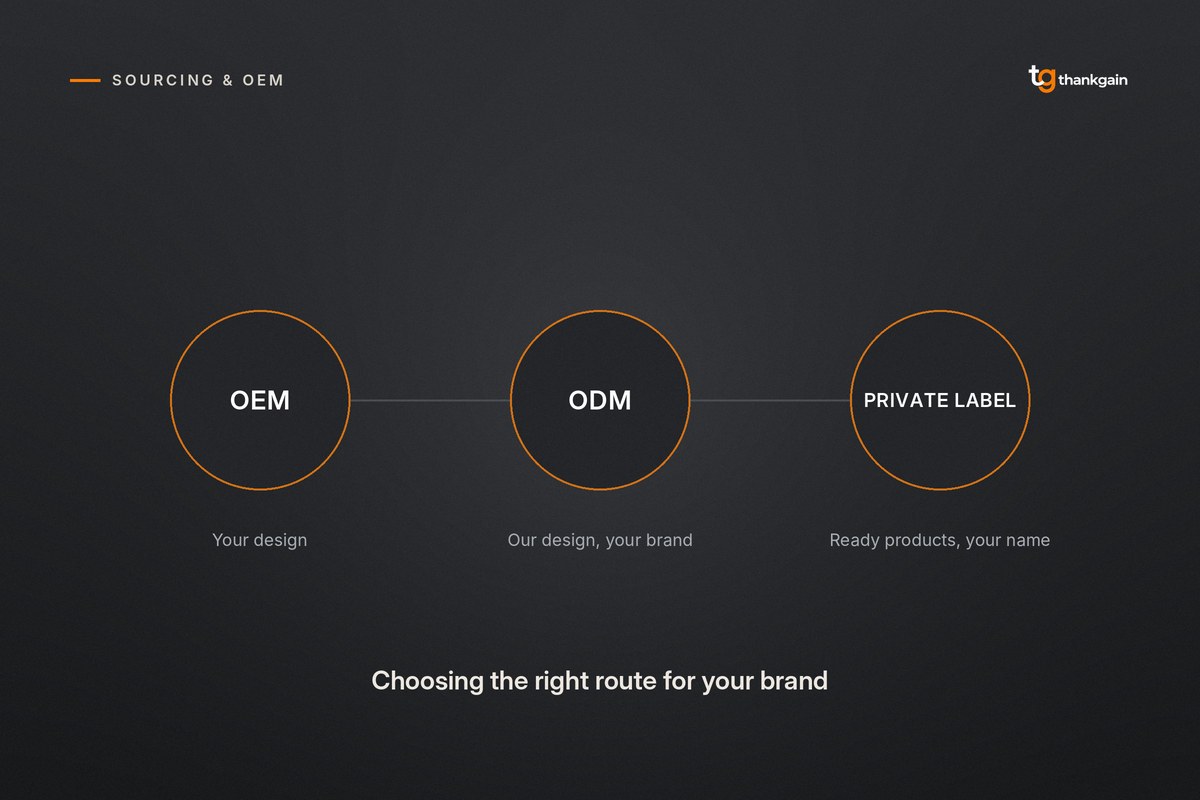
OEM (Original Equipment Manufacturing) means the product is built to your specifications. You provide the design, technical requirements or reference samples, and the manufacturer produces it.
- Best for: brands with their own product design or clear technical requirements
- Control: highest – the product is defined by you
- Time and cost: typically higher, since tooling, engineering and testing may be needed
ODM – our design, your brand
ODM (Original Design Manufacturing) means the manufacturer already has a developed product design, and you adapt it for your brand. Adjustments can include colors, materials, functions, accessories and packaging.
- Best for: brands that want a proven product with a degree of customization
- Control: medium – you choose and adjust, but the core design already exists
- Time and cost: faster and lower than full OEM development
Private label – ready products under your name
Private label is the most direct route to market. You select an existing product and sell it under your own brand, usually with your logo, packaging and manual.
- Best for: distributors and brands that want to launch quickly
- Control: focused on branding and presentation
- Time and cost: the fastest and most cost-efficient option
Quick comparison
| OEM | ODM | Private Label | |
|---|---|---|---|
| Who designs the product | Buyer | Manufacturer | Manufacturer |
| Customization level | Full | Medium | Branding & packaging |
| Development time | Longest | Medium | Shortest |
| Upfront investment | Highest | Medium | Lowest |
How to choose
Ask yourself three questions:
- How unique does the product need to be? If differentiation is the core of your strategy, OEM or ODM gives you more room.
- How fast do you need to launch? Private label and ODM shorten time to market considerably.
- What is your budget and expected volume? Deeper customization usually requires higher volumes to make sense.
Many brands start with private label to test a market, then move to ODM or OEM as volumes grow.
How we work with B2B buyers
Thankgain supports all three models. Our process is simple:
- Select – choose from our curated range or share your requirements.
- Define – agree on specifications, colors, branding, packaging and target market.
- Sample – review and approve samples before production.
- Produce – manufacturing backed by over 15 years of experience in Shenzhen.
- Deliver – export coordination to your market.
Not sure which model fits your project? Send us an inquiry and we will recommend the most efficient route for your brand.